Showing posts with label Silkie. Show all posts

Wednesday, 29 May 2013

Frankie Magazine Article Review - Feeling Clucky by Eleanor Venables

Frankie Magazine - May/ June Edition

I read an article in the May/ June edition, Issue 53 of Frankie magazine - Feeling Clucky by Eleanor Venables.  It's a half page article so it's not intended to be a complete guide to keeping chickens in a suburban setting.  It's a short piece to encourage city dwellers to consider becoming hen parents for company, eggs, gobbling of kitchen scraps, garden maintenance and for something a bit different.  Unfortunately the article drags up some standard clichés about hens and that just annoys me.  The article is meant to encourage people to consider keeping hens, however it also presents chickens in a less than positive light.

 Stupid?

Whilst recommending that chicken owners offer their flock a sturdy water bowl, one that can not easily be tipped over by a pair of roosting feet, the author uses this topic to segue-way into a slight about how apparently unintelligent chickens are.  She references a story that a headless chicken once lived for 18 months.  The story comes from an event more than half a century ago, where allegedly someone tried to cull a chicken by cutting its head off, did not do a proper job and so they left part of the head in tact.  Thankfully (if the story is in fact at all true anyway) the bird did not succumb to infection and die a hideous and prolonged death but apparently lived for a number of months afterwards.  The author uses this vile tale to highlight how chickens are "not the smartest of animals".  Can you imagine how upset people would be if a dog sustained a severe head injury from an attempt to exterminate it but yet managed to survive and stay alive for months afterward?  It would be this enormous mixture of outrage at the person who mutilated it and celebration at the marvellous dog.  But for a chicken it's assumed that pain and discomfort are either not an issue or of no consequence as it's 'just a chicken', they hold no value anyway so who should care - let's make a joke out of a badly wounded bird and as this author suggests, chickens have minimal intellect, this story backs it up.  I have had some great chickens with long term memories, problem solving skills and gorgeous and varied natures and others who are simple, straight to the point and predictable.  Much like people there is no such thing as 'you've known one you've known them all'.  They are varied, unique and you never know what you're going to find once you get to know them.  Certainly I'd trade the most difficult and unusual chicken for the most difficult and unusual human every time. 

Nasty?

Then there's the description of a rooster.  I do hate generalisations that put everything (especially an animal for heavens sakes) in one box and determine it to be abhorrent.  The author describes roosters to be nasty, having mad, beady little eyes and being known for their aggression.  Some roosters are very aggressive and a real handful.  This is often a combination of genetics (some breeds are particularly skittish and difficult) and a lack of frequent, caring, human contact from a young age.  However the few that I have purchased (hoping they were hens) I have had from tiny chicks, handled them every day, treated them with great care and respect, have grown to be spectacular gentle-men.  I've never been silly enough to tick my neighbours off with pre sunrise crowing and more or less beg the local council to come confiscate them, by keeping the boys in the long run.  Roosters keep the hens beautifully in check, lower the petty squabbles amongst the girls and nurture and protect the hens to such an extent that they often run themselves down.  They are amazing, gorgeous and might I add completely innocent animals who are doing nothing more than following their inbuilt instincts - crowing to announce the day, determine territory, bring the flock together and protecting their girls from any perceived threat.  
If you saw something unknown, untrusted, 40 times your size coming at your family, wouldn't you try to protect them? 

Poorly Researched Dietary Advice

As for the advice about feeding chickens, not so good.  The author says that "aside from onions and garlic, most veggies and fruit are great for them".  Garlic is considered a go-to as a natural remedy for pest control and a general tonic for good health.  My girls get an occasional spoon of garlic granules for a little treat and when their father gives them a cheese free hamburger, they all enjoy a little sliver of onion.  I don't think any reasonably brained person would think of raising an onion and garlic fed hen (imagine that on the packet of a frozen chook next to the grain fed choices) as it's clearly not intended to be a staple component of their diet.  I don't remember evolutionary history being full of chickens frolicking in the garlic fields, guzzling onion rings for dessert.  As an occasional aspect in small amounts, there is absolutely nothing wrong with onions and garlic in a chicken's diet.  I get curry about once a fortnight and there is always plenty left over for the girls the next day.  This is certainly no way to take a short cut to curried eggs!  
What I would say about something not to feed chickens is that feeding them huge armfuls of lettuce (such as you can find in a lot of produce departments on-floor bins that people have peeled off the lettuce heads).  Lettuce has almost no nutritional value at all and in large amounts it leads to chickens having really watery droppings and therefore soggy bum feathers to attract flies and burn the skin. Feeding a few leaves between several hens should be no problem amongst a variety of other food choices.  We feed our girls silver-beet as it has some great nutritional elements.  It's also really easy to grow if you're inclined. 
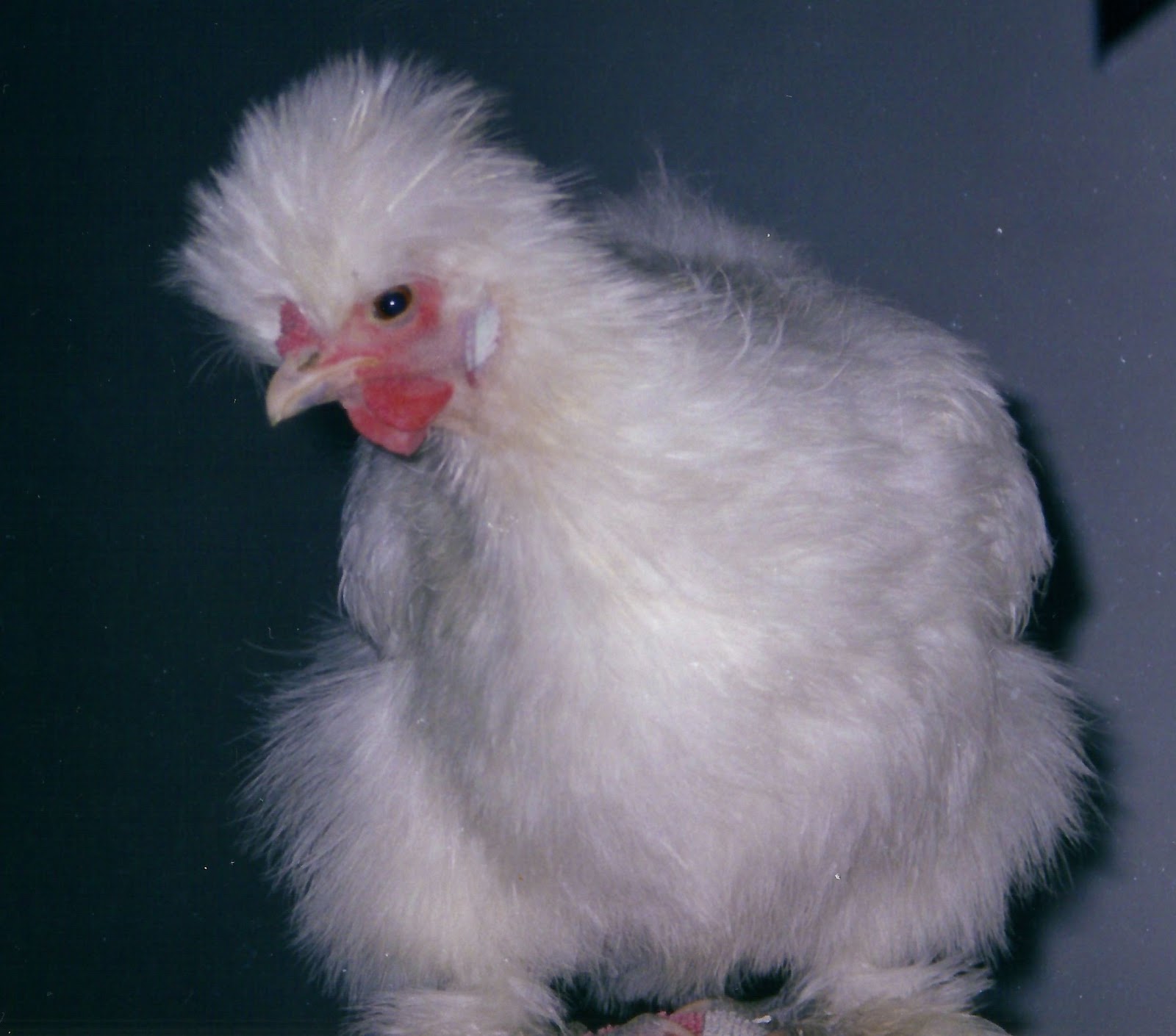
I don't mean to be intentionally picky to the author but there is no such breed as a 'Silky Bantam'.  The term is Silkie and they are not bantams.   They are also not a chicken you would buy for their fabulous laying prowess as the article indicates.  They do indeed "look awesome", are generally easy to handle and tame-up well with regular calm and gentle human contact.  They do not have "scrawny feet", they have feathered feet which I have had people gush over for years in excitement and amazement.  

I wish that if someone writes an article to encourage people to keep chickens that it be factual, fair and do what it sets out to do - encourage, celebrate and spotlight chickens.  

Sorry Eleanor Venables but in the immortal words of Kath Day-Knight, "It was good but I don't agree".  


Rosa and Farrah (Silkie hen) - beautiful, brilliant and beloved.  

Wednesday, 20 February 2013

3 in 4

Today we had our 3 year old white Silkie hen Angie put to sleep.  In less than 4 weeks we have lost Bantam Wyandotte Amelia, black Silkie hen Jetta and now Angie.  We had a flock of 9 to begin the year and it's so sad to see 6 beautiful girls remaining with no certainty or relief of this nasty run of ill health.
Angie - gone but never forgotten and always loved

ILT Testing

Angie has been sent to the WA Department of Agriculture to be tested for ILT.  There is no way to test for ILT other than post mortem.  It's really sad that Angie will not come back home for a proper burial.  We've only ever had 1 other hen in more than 15 years not come home and that was by nothing more than a poor decision on my behalf.  

I do hope that ILT is not detected.  This would then lead the way to other potentially less serious possibilities eg. fowl diptheria/ wet fowl pox or mycoplasma/ chronic respiratory infection   ILT means no new chickens.  Not unless we want to infect previously healthy birds with a vicious viral condition.  It would mean keeping those hens we do have until they have all passed away  After which we would basically raze the existing pen, wait several weeks and then considered starting from scratch.

Jetta - 9 years of loveliness.  Fowl Pox proved too much.


Fowl Pox

In the mean time we have had Wheaten Pekin hen Alice, black Silkie Farrah and Buff Pekin Holly all with Fowl Pox.  Alice went back in to the pen on Monday 18th February.  We kept her in the house for 17 days to try and stop the spread of the Pox virus.  Such a beauty.  Alice is so tame and gorgeous.  She would bounce out of her hutch once the door was unlocked and come in to the kitchen to preen on the floor, await feeding and have a chat.  If we went outside or out of view she would call and call.  I could hear her screaming from the kitchen, no doubt the neighbours could also hear her at 7:00am as I was feeding the other girls in the garden and I'd come running in the house to tell her everything was okay.  Our dog Madi developed a bit of a fancy for Alice, typical Jack Russell stalker.  Otherwise it was all smooth sailing.  I was really happy to see Alice lay her first egg in more than 3 weeks on Monday.  She's also massively fat (in a healthy hen way) and eating well.  I have great hopes for her and her sister Holly who is equally ravenous and portly.

A Crowing Hen

Our remaining girls Selene, Rosie and Jewel have shown no signs of Fowl Pox infection.  Though both Jewel and Selene are moulting and are ripe for all sorts of nasties.  The only odd behaviour is Selene crowing occasionally.  But that's pretty standard for her.  Being the dominant hen and having her hormones twisted up at the end of the laying season she's inclined to go rogue and lose the plot a bit.  It does her no harm and due to the hit and miss nature of the occasional crowing it does not bother the neighbours in any way. I've seen Selene faux mate with the hens on occasion.  She takes her role as head chicken very seriously indeed! 

Selene - a hen in disguise

Once Again, in Writing

It's really deflating caring for the girls when they're so sick and then thinking about writing it all down on top of the medicating, Vet visits, hutch cleaning, daily hen linen laundering, crop feeding.  It just goes on and on and as much as I love them and would do it all again it does feel pretty awful to then relive it all in writing.  So the Blog suffers as they suffer.  But I do hope to get Angie's ILT results within 1 week and either move forward or deal with a rather bleak future as best we can.          

Sunday, 9 December 2012

Celestial Sunday - Part 6

Egg Peritonitis

I had a vile run of egg peritonitis in my chickens and the first off the line was my Celeste.  I first met my now long term Vet after taking Celeste to the local dog and cat Vet and getting referred onwards.  There are very few poultry competent Vets in Perth.  I could feel a grinding sensation in Celeste's gut and knew something was wrong.  Celeste was diagnosed with egg peritonitis.  

I have tried to find a decent, reputable and easy to understand on line article about what this is but so far nothing matches the requirement.   Pretty much the egg does not make its way successfully along the chain and the liquid contents (yolk and white) settle in the abdomen.  They begin to cause inflammation, resulting from an infection caused by the egg contents stagnating in the abdominal space.  It also results in egg being produced which have a flexible, weak, rubbery shell - not a shell at all actually, it's like extra thick tissue paper at best.  Often call soft shelled eggs. Celeste was more than three years old when her symptoms began. 

We went through some odd treatments.  I recall taking Celeste in to the Vet to get her abdomen drained.  Basically the Vet stuck a rather large gauge syringe in to Celeste's abdomen and this prompted beer coloured liquid to drip out like a tap - a cup of it spilled out on to the surgery table.  I was horrified but it gave Celeste a lot of relief at the time.  I remember she was unable to make a sound but by the time the draining was half way over, she was chatting away again.  

How to give oral medication to chickens


I also gave her eye dropper fulls of anti inflammatory liquid.  My biggest piece of advice to anyone giving chickens oral medication is to avoid pressing the hens eyes when holding the head still.  So, so important.  I gave Celeste liquid medication dozens of time and she lost her sight almost completely months in to the treatment.  I'll never know if maybe I was pressing her eyes when trying to keep her mouth open and permanently harmed her.  

Odd moments in the battle against egg peritonitis included;
  • When soft shelled eggs were on their way, they would cause Celeste huge pain and long drawn out pushing sessions.  The very best way to deal with this is to (and I recently had to do this with one of our elderly hens so I know it's not just silly, sentimental, mumbo jumbo), wrap the hen lightly in a towel - for warmth and to contain her and sit with her on your lap if she'll stay or at least close to you to allow your body warmth to keep her additionally cosy.  I had our latest hen wedged between the couch arm rest and the left side of my torso.  The egg usually comes out within the hour.  Just keep her warm, quiet and comfortable.  So Celeste would be wrapped up in front of the tv with me, laying a rubbery shelled egg on my lap - it was like a home birth of sorts.  
  • Celeste became egg bound (egg stuck just prior to exit) and I found her wandering the backyard, pushing every couple of metres and complaining loudly as she wasn't able to enjoy a scratch in the garden.  I took her into the house and popped her on my lap.  I waited for her to push and then pressed with a mild firmness behind where I assumed the egg was.  When the egg did not come out I stopped and waited for her to push out again.  On the third go the egg shot out like a bullet.  It flew out more than a metre beyond her and she made a sharp squeal to announce its departure.  I showed her the egg and she stared at it and then back to me and then back to the egg, chatting away to me.  Five minutes later she was back in the garden and very pleased that she no longer had an egg blocking her.  It was as though something very inconvenient had stopped her having fun.  She never let anything bother her long term.  
  • The constant infections finally wore down my girl and I remember sitting in the waiting room of the Vet to finally have her put to sleep (she was emaciated, exhausted, blind and couldn't stay awake more than a minute or two at a time).  But she would open her eyes and yell and carry on at the top of her voice - this was standard Celeste language for either; I'm bored/ I'm hungry/ I want to be in the garden/ I want to come inside.  Then she'd go straight to sleep.  Couple of minutes later she would bolt awake and start screeching again.  It was so gorgeous.  Even at the end nothing could get her down.  

How to put an end to Egg Peritonitis

If I had my chance again, I'd find a Vet who would perform an operation to remove her ovary.  A week or two and she'd be well on her way to recovery.  There'd be no months of pain, inflammation, medications, abdominal drainage, perhaps no loss of sight.  Most of my other hens have developed egg peritonitis in their first year or so and if I were breeding my girls, I would at least wait until at least they were 2 years of age before breeding them.  Many things will have taken their toll on a hen by two years eg. cancer, egg peritonitis (Celeste was unusually late in her presentation), diabetes, and it prevents genetic problems getting passed on to the chicks if you wait out the majority of the bad conditions and breed from the healthiest stock.  
Hens like Celeste taught me so much and her sacrifice and difficulties served to provide the hens that have come after her with greater happiness and better health.  Whenever I give my hens oral medication and I carefully cup my hand around their heads, carefully avoiding the eyes - I have Celeste to thank for this.  

Celeste - egg on the way.  My little champion. 


Sunday, 25 November 2012

Celestial Sunday - Part 5

Chicken Chauffeur

So I'm not recommending this at all.  However at the time I thought not much of it at all - other than that it was very cute and clever indeed.

As Celeste used to travel around with me a great deal, she became very comfortable in the car and established a very reliable routine.

I drive around now and see dogs clambering about jumping over passengers, over drivers, out windows - so maybe what Celeste did wasn't altogether, completely inappropriate.  

All of my hens now travel in a carrier - the same kind designed for a cat.  They have a towel in the bottom and a special water cup and food container.  There's a nice photo of my hen Ruby in her carrier when I brought her inside on a hot, Summer night.  The seat belt gets looped through the carrying handle, so they seem quite safe.  

In the Celestial days I didn't have a carrier, so instead Celeste sat on my lap whilst I drove.  She got so used to it that she knew exactly when to sit down and when to stand up.  At the traffic lights she would stand up, start to preen herself and when I got going again, she would sit back down on my thigh and wait until the next stop.  I never had to place my hand on her to keep her still, she just got it.  We can't even get our dogs to behave themselves half as well in the car.  I used to keep a water bottle on the passengers seat and when we were stopped, I would pour water in to my palm and she would have a drink.  

I wouldn't drive with a hen on my lap today but I also know I'll never have another hen who'd be capable of understanding how to behave in the driver's seat.  


Celeste - with the unwanted, newly covered armchair in the background.

Sunday, 18 November 2012

Celestial Sunday - Part 4

Seeking a Friend

After about two years of being an only child we decided to get Celeste a friend.  Seeking a friend for a hen requires some careful planning.  I didn't want to get her a friend who was actually the equivalent of a school yard bully and I also didn't want her giving some poor, little chick a hard time because she was bigger and older than them.  

I went back to the suburb of Forrestfield, to the same little farm where we bought Celeste and chose a black Silkie hen of around 4 months of age.  We called her Sylka.  I foolishly took Celeste along for the ride, thinking she'd be so pleased to see other hens, but all she wanted to do was fight them and she gave Sylka a few hard pecks on the head during the drive home.  This is nothing new and in fact had Celeste not wanted to fight with the other hens, it would have indicated that she was most likely very ill.  Chickens love a rumble. 
Little Sylka was a sweet hen.  She filled her role as hen companion to her majesty Celeste very well.  She was submissive to Celeste but Celeste also wasn't very hard on her, so after a couple of weeks they settled nicely in to a positive relationship. 

Sylka was also quite a bit smarter than Celeste.  Celeste was used to having everything hand delivered so never particularly tried too hard to look around for food etc.  Sylka on the other hand quickly worked out that when I lifted the flap on their sleep hutch, that there would quite often be crickets and other bugs ripe for the picking.  I remember accidentally dropping the flap and really scaring her.  Her memory of the event was excellent and she took over two weeks to again be comfortable being front and centre for the unveiling every morning. I had to coax her towards it bit by bit.  


Sharing the rocker - now that's friendship
Celeste introduced Sylka to the joys of scratching in the front yard and enjoying the rocking chair.  Celeste even allowed Sylka to join her on the chair - providing Celeste had exactly the position and amount of space she required.  

Celeste no longer screamed at us when we left the house and she seemed to generally calm down and behave more like a regular hen, rather than a spoilt child.  My brother built them their own house and enclosed a good sized section of the garden for their use.  We also planted a lemon tree in their garden for some shade.  In the Winter I would get worried for them as their house had a tin metal room and the rain beating down on it must have been horrendous.  The logical response being to bring them in to the house, put down a towel, put their basket on top and reinstall them in their basket - immediately next to my bed of course.  I would get woken up by Celeste preening.  I swear that hen preened for hours at a time.  I still sometimes say to my husband that I would love to have our current girls sleeping beside the bed - but I'm trying to pretend that I've grown past that, so haven't actually gone through with it so far.  

A new pen with custom built boudoir

Saying Goodbye

Sylka wasn't a particularly healthy hen and over her time she had some weird health issues. A Protozoa bug got in to her gut but that was the tip of the iceberg.  She would often look really shabby and not grow back a healthy coat of feathers in the moulting season.  Later on another hen had the same problem and was given thyroid medication which helped enormously but unfortunately it was too late for Sylka.  She finally succumbed to cancer.  I really wanted to know what had taken her life as she was so skinny, lethargic and miserably we had to have her put to sleep.  It's only the second time that I have had the Vet conduct an autopsy and this confirmed the presence of tumours.  Probably caused by a viral, poultry specific condition called Marek's disease.  

Because she had been autopsied we decided to bury her without opening up the paper which her body was wrapped in.  She had only been gone a day so Celeste was missing her but I figured that seeing Sylka in her post autopsy state would be too distressing.  It was a stupid thing to do and I really think much of the decision had to do with me not wanting to know what state Sylka was in after the Vet had done his work.  Celeste searched for Sylka for days and days and days.  It was bloody awful and I do not forgive myself for not cleaning up Sylka and allowing Celeste to see her one last time.  Hens are very quick to work out when a hen has passed away upon viewing the body.   

One Last Lesson

Because of this experience I make a point of showing the hens the body of the chicken that has passed away.  I lie the hen carefully on the paving in the middle of the pen, the other hens grow silent and skittishly creep around the body, sometime giving it a nudge like peck, calling to her perhaps and after a minute or two they turn away and go back to their business and I can then bury her. 

The few years that Celeste had Sylka were possibly her most comfortable (she was never without her) and also her happiest.  I wouldn't keep a solo hen again.  Hens are very social creatures and deserve the constant companionship of another animal that respects and understands them at all times - not just outside of office hours.  

Sunday, 11 November 2012

Celestial Sunday - part 3

No honey, that's a seagull...

Fantastic Celeste moment in 1998 when she was taken down to Lake Monger for an outing.  She was out on the grass, ducks and swan milling around gawking at her loveliness.  It was all fairly overwhelming for Celeste and she was wide eyed and staying quite close to me.

A guy ran by with his toddler in a pusher (stroller) and his little girl hung out the side and said, "Daddy, a chicken!".  He did the usual thing that parents do, imagining his daughter was having a three year old moment and said in a patient yet tired tone, "No honey, that's a seagull".   He glanced over and then did a huge double take, head swiveling wildly, staring back at Celeste, "No you're right, that IS a chicken!" and kept running, still staring behind himself.  

It was quite a day for Celeste as to get to the lake we first went through the drive through at a world famous chicken take away restaurant.  Celeste was on my lap and the girl working the drive through service was giggling herself silly as Celeste peered up at her.  Celeste enjoyed some bread and a bit of a chip as she made her debut at the lake later on.  

Just another day in the life of a chicken princess in Suburbhenia.  

Celeste - clucky at 5 months old.  November 1996


Sunday, 4 November 2012

Celestial Sunday - Part 2

Peck, if you can't reach the door bell

Celeste expected to be able to come into the house whenever she wanted to but entering via the front door was her greatest achievement.  Most afternoons Celeste could be found in the front garden, enjoying herself and amusing the neighbours.  We never had to keep an eye on her and she absolutely never went anywhere near the road.  
She used to love it when I turned on the hose and the water would run through the grass.  She would drink it from between the patches of turf and even when she went blind in her last year, she recognised the sound of the water running and would still run her beak through the blades and drink happily.  

Enjoying an afternoon out in the front garden
When the sun began to go down, she would be ready to come in and prepare for bed.  She would come to the front door and announce herself by pecking on it repeatedly.  She actually taught herself how to knock on the door.  


A Seated Attack

We would then hold the door open, she would walk in to the lounge and then fly up to the head rest of her commandeered recliner chair.  From there she would thoroughly preen herself all over and finally as the sun was nearly completely gone, she would sit down and start to fall asleep.  We would then pick her up and take her out to her pen for the night. Celeste completely took over the chair and my brother would deliberately taunt her by trying to sit on it when she was preening.  She would attack his head and if he tried to swish her away with his hand, she would grab him.  I remember her getting so upset, that she grabbed the top of his hand and twisted so hard she slightly broke the skin.  Good girl Celeste! 

Celeste - guarding her chair and preparing for bed

After a couple of years of this, we decided to have her chair recovered.  She had pecked away some of the threads from the top and it was fairly old fashioned being dark brown velvet.  I still feel guilty about the decision.  After the chair had been taken away, Celeste came in to the lounge for her usual routine.  She walked up to the corner where her chair should be and stared and stared.  She called again and again, looking at us with so much confusion.  We tried with another chair but it was no use.  She was really shocked and clearly upset.  
But she did allow well behaved friends to share her chair from time to time
We were really keen to get the chair back for her and about 3 weeks later when it arrived, we were sure that she was going to be so happy.  She wasn't.  The chair was a completely different colour, texture and foam density.  We tried to lift her up to the top of the headrest but she wouldn't stay up there and never jumped up on to the chair ever again.  Her afternoon routine was completely disrupted and although she still enjoyed her time out in the garden, there wasn't anything to come inside the house for at the end of it.  

I can understand why she gave up her chair but what I still don't understand is how a chicken knows to knock on a door when she's ready to come inside? 

How calendar worthy does my girl look in this photo hey?

Celeste - treated like a princess, behaved accordingly. 


Sunday, 28 October 2012

Celestial Sunday - part 1

Celeste - the beginning of a Legend


This little hen is my most talked about of all of the girls.  Anyone who knew me at this time remembers Celeste.  She lived with us - in the house when we were at home.  She took over a recliner rocker, if we were seeing family she came with us, she slept over at my work sometimes and she broke our hearts as she called for us to come back when we had to leave the house.  

My brother and I bought her from the Perth suburb of Forrestfield in late May of 1996.    We were looking in to the big box of Silkie chicks, who were running away at the site of the breeder's hand entering their house.  A little, white chick sat patiently and looked up at the hand without fear.  The decision was made for us, by her.  It was as though she knew who we were and was waiting to go home.  

She was 2 weeks old and so tiny that I could wrap my hand around her, so that just her head could be seen poking out through the circle of my thumb and index finger.  Being an only chick, Celeste filled our lives and our house at every spare moment.  Her inherent lack of fear towards people allowed her to adapt to all kinds of situations.
A music lover...

Helping out in the kitchen

Taking over the dining room table


 On her recliner rocking chair
She was an awesome hen and I will be running a series on her over the next few Sunday mornings.  It's funny that what seemed quite normal at the time is actually on reflection, truly amazing and had I not been there to live it, almost impossible to believe. She showed just how adaptable and domesticated a bird can become when given the freedom and love to learn and be involved in our every day moments.   

As my great friend Mike still says - Good girl Celeste.